Wednesday, December 20, 2017

Some Christmases Are Like Roller-Coaster Rides

Life is often like a roller coaster ride. Things are going great; then the bottom drops out of your life; then you start to climb again. The Christmases of 1965, 1966 and 1967 were like that.

Our home in Bountiful Christmas 1965
In 1965 we had purchased a home on Orchard Drive in Bountiful and our beautifully decorated tree in silver that Christmas symbolized that “perfect” life. Both Ed and I were working—Ed for Zion’s First National Bank and I for GMAC (the financing branch of General Motors). We’d purchased a new Pontiac at wholesale through my job, and Ed was taking a full load of college courses. He was due to graduate from the University of Utah in less than a year. Most exciting of all, after two years of marriage we were expecting our first child.

But that he dropped one class in January of 1965; That made it so he wasn’t taking enough college classes for him to be exempt from the draft, so he was eligible to be drafted in the Vietnam War. He joined the Army as a candidate for flight school and was gone before Valentine’s Day. I miscarried the baby I was expecting, and moved back home with my Dad.
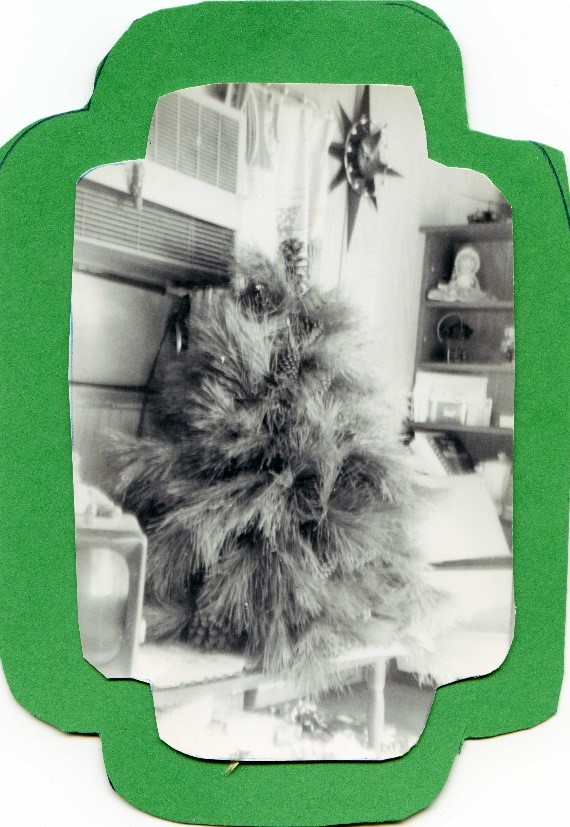
Our homemade Christmas tree
Christmas of 1966 found us in southern Alabama living in a trailer while Ed was attending army flight school. Everything we had with us had fit into the car I’d driven down to be with Ed during flight school. We’d lost the nice home, of course, but we were together. We had no phone, no Christmas tree, very little material goods. I’d miscarried not only the baby I’d been expecting the Christmas before, but another baby a few months before.
My dad wrote and asked what we wanted for Christmas and I asked for a case of Danish Dessert! I loved it, and we couldn’t buy it anywhere down in Alabama.

We couldn’t afford a Christmas tree, so Ed took some chicken wire and wrapped it around the evergreen branches that we cut off, and made a small two-foot high “tree” for our trailer and put pine cones on it for ornaments. (We wouldn’t have had a place to put a real one anyway.)

I went to the library and got old newspapers and we cut out the things we would have
Some of my Christmas "wishes"
liked to buy each other for Christmas and we put them in envelopes which we gave to each other as our Christmas gifts. Christmas morning was so cold, the pipes were frozen, so we had no water—no Christmas dinner for us! However, I was determined to call home and talk to my family.

In those days you could call anywhere in the United States for $1.00, so I searched every couch, every car seat, every chair to find a dollar in change. Then when I had enough, Ed drove me to a gas station where I changed the coins for quarters to call home. It was the first time I’d talked to my family since I’d moved away to join Ed. Talking to them was a wonderful Christmas gift.

Then we went home and that afternoon, when we had water, I cooked Danish Dessert.
They had closed the flight school and the base for two weeks for Christmas, so we had two weeks’ vacation, whether we could go anywhere or not.

We and some of the other poor flight school couples stayed on base in our trailers and met every day to play board games with each other. It was fun. I don’t recall wishing I could have gone sight-seeing, or touring; I was so glad I could be there with Ed.

The Army’s Christmas gift to us, of course, was Ed’s orders for Vietnam as soon as he finished flight school. He received them on the last day before Christmas break. The reality of them hovered over us like an unspoken threat all during Christmas. No one wanted to mention them, but they were implicit in everything we said and did. All during Christmas I wondered, “Where will he be next year? What will he be doing? Will he be alive?”

The Christmas of 1967 found Ed fighting in Vietnam as a helicopter pilot.  I was back in Utah alone—except for our baby son that I brought home on Christmas Day. Ed was able to call me that Christmas season as the Red Cross contacted him, and he called to congratulate me on our son.

Life was on the upbeat again  
as long as we were a family!


Key to My Dreams

Can you wrap a dream in gift wrap and give it to someone? Can you tie up hopes in red satin bows and

make them come true? The Christmas of 1961 my parents found gifts that were the key to my dreams and changed my frozen heart to one filled with optimism.
Christmas of 1961 was cold and bitter, but I seldom felt its frigid bite because my heart was enclosed in a casing of ice. It was my senior year of high school, but my life at home had changed drastically.
My older brother had left for a mission for our church which put an economic strain on our family, and my mother’s failing health seemed to spell doom to my dreams of college. As I was the oldest girl in my family, going away to college seemed selfish and impossible. Because of my disappointments and worry about my mother, I became secretive and resentful. Rather than enjoying the season, I made life miserable for everyone.
When Dad offered to take me shopping, I griped that I had too much to do. When Mother asked what I wanted for Christmas, I snapped back, "Why even ask? We can’t afford anything anyway!" My younger brother and sisters quieted in my presence, fearful I’d bite their heads off as sport.
My mother knew that I was unhappy, but I obstinately refused to tell her what had blighted my life.
Perhaps I felt that it would be one more heavy burden for her to carry so I refused to let on how much college meant to me.
My sweet mother with her gentle smile and unselfish heart had quit high school to support her family when her father died during the Great Depression. She was very intelligent, but she had never even been able to finish high school. In some explainable manner, I felt that I needed to get an education both for myself and for her. Now that my college dreams seemed impossible, I buried my hopes beneath a surly attitude and made myself miserable. I knew no one could find the key to unlock my dreams.
That Christmas morning dawned cold and clear. I growled when the younger kids tried to entice me to see what Santa had brought because I knew that what I wanted most could not be found under a Christmas tree. But I was wrong.
Santa hadn’t left a bushel of expensive trinkets for any of us. But my parents, with perception and hope had unlocked my heart with two unique and special gifts—a small bound book of Emily Dickenson’s poetry and a vinyl soundtrack of my favorite musical, Carnival. I looked at my mother and began to cry.
“How did you know I loved Emily Dickenson?” I sobbed.
“I called all your friends until I found out what you’d been talking to them about. You’ve always wanted to be a writer, and Sharon told me that your favorite poet was Emily Dickenson. The book will be useful when you begin your English studies at college next fall. Linda told me that you loved Broadway musicals. I hope you like the one I picked out; maybe it will do until you see one on Broadway someday.”
My dad was mumbling about the gifts he wished he could have given me. He said that when he won the lottery he’d buy me bushels of Janzten sweaters. But I didn’t hear him.
Through my tear-filled eyes, I could see their vision for me. It was a vision that I hadn’t dared dream about—that my mother would not live long enough to see.

Gifts are merely symbols of what we would really like to give others. For how can you wrap love inside silver paper? How can you place a red satin bow around dreams? How can you gift someone with hope and confidence? That Christmas my mother had searched for the key to my dreams. And she had succeeded.

Sunday, December 17, 2017

Childhood Christmas Memories

There were three memorable childhood Christmases that I remember vividly. Each were different, and each were special in their own way.

My earliest Christmas memory was when I was about five or six years old. For years my father hadn’t had a good job, and money was very scarce, but that year my dad had gotten a good job at Hill Air Force Base. So, money seemed to be secure!

We drove to Monroe, Utah where my paternal grandmother lived to have Christmas with her. It was the one of the few times we hadn’t had Christmas at home, so I was especially excited.

My grandmother’s home was very simple and basic; there was a stove in the kitchen which was used for heating and cooking, and a large pot-bellied stove in the living room. But we never felt the cold as we rejoiced in a family Christmas. My dad took my older brothers up into the mountains to cut down a Christmas tree and we decorated it with lights and icicles.

My mother was 1st generation Danish (her parents had been born in Denmark), and Danes always opened their Christmas presents on Christmas Eve. My dad wouldn’t go along with that, but he did allow us to open one present on Christmas Eve.

My deceased grandfather had always enjoyed playing Santa Claus, and visiting the houses,
distributing the gifts that the parents had purchased. So early Christmas morning my father had arranged for a Santa to come to our house with our presents. I still believed in Santa Claus, so I was awed that I could really talk to him. He opened his bag and pulled out a large wrapped box. I couldn’t believe such a big box was for me, but I quickly opened it and discovered a large 14-inch Madam Alexander “Beth” doll.

That whole Christmas, from being at Grandmother Hansen’s, to my dad and brothers cutting down a real tree, to an authentic visit from Santa was memorable, but to receive such an expensive and special gift—a doll named after the “Little Women” character just as I was, was unforgettable.

The next Christmas I remember, I was about 10 years old. We lived in a large house on Pages Lane in Bountiful, and I remember the beautiful bubbling candle lights on the Christmas tree. They seemed magical to me.

I knew all about Santa Claus, so did my younger sister, Coleen; she also knew that our tradition of opening one gift at Christmas was going to help us see what Santa had brought us, before morning.

Because of our Danish heritage, we could open one gift on Christmas Eve and my Coleen, pointed out to me the gift I should open. When I opened it, I discovered a rudimentary knowledge box game with questions and a probe on a wire. There were question pages you’d put on the box and if you put the probe on the right answer, the big light on the box would light up. (I had one like that for my own children and my oldest son dissected it to see how it worked.) If you put the probe on the right hole, it completed an elementary circuit, which turned on the light!


We waited until early morning (we may have slept a little, but not much), and then we snuck from our room into the living room. There were no lights on the Christmas tree, and the house was very dark, until we put the probe in the right hole (we couldn’t see the questions, so it was trial and error). Then the light glowed, and we could see what was under the tree. I don’t remember what I got for Christmas, all I remembered was us going around and looking at all the unwrapped presents under the tree. We didn’t touch anything, even the gifts we’d be getting, and we went back to bed (probably not to sleep) until it was light, and we could get out of bed. The reward wasn’t the gifts, but out-foxing our parents to see what we’d get before morning.

The last Christmas in that house on Pages Lane was special because my mother was expecting a “Christmas Baby,” and she had it two days before Christmas. I don’t remember what I got that year for Christmas. What I was excited about was that at 13 years old I was old enough to go to the hospital on Christmas morning and carry home the new baby.

There is a story that my youngest brother had gotten into his water color paints and eaten them, turning his mouth all colors and worrying everyone that he might be poisoned. But I don’t remember that either—I just remember the wonder of a REAL Christmas baby.


Monday, November 13, 2017

Flying Blind

Flying Blind

By Edward O. Dayley (RET MAJ/USA)
As told to Beth Dayley

As an operations officer in the Americal Division, and one of the few instructor pilots, I often would give check-rides or evaluation flights during my second tour of duty in the Vietnam War.  I was assigned to Chu Lai; the mountains rise straight up above the smooth, serene beach.  The terrain is thick with vegetation hiding all kinds of animal life. 
Early each morning we’d all meet together in the operations center to receive our missions and be briefed about their specifics.  One memorable morning in March 1971, I plotted out my flight plan for the check-ride and inspected my helicopter.  I was frustrated when I discovered that the skids on my aircraft weren't right.  It was a minor problem, but because running landings were required on check-rides, I needed good skids.  A nearby pilot heard my complaint and offered to switch aircraft with me.  He was dropping troops into a site high in the mountains.  It was a dangerous mission because of the locale and terrain; however, he wouldn't be doing any running landings, so the bad skids wouldn't be a problem for him. 
The check ride was routine and smooth and as the pilot flew, my thoughts slipped back to the past and how close I almost came to not being a helicopter pilot at all.  I’d grown up in a small town in Southern Idaho with an alcoholic dad and a working Mom.  I had learned to work hard, and had to earn everything thing I’d received in life, so compared to my teenage years, flight school had been a snap.  But towards the middle of the nine-month course, we got into instruments and I hit a mental cement wall. 

A lot of flying is trusting your instincts, "flying by the seat of your pants," and I excelled at that.  Instruments meant "flying blind" which was just the opposite.  I was put in a flight simulator which blacked out all outer sensations.  Then I had to learn to trust not what I felt or thought, but what the lighted panel told me.  Time after time, I messed up because I felt I was flying straight and level, yet the instruments showed I was in a tight descending turn!  I fought and fought against the necessity to trust something other than my own instincts. 

Finally, when I had become resigned to the fact that I would probably fail the course and end up in Vietnam as a foot soldier, I stopped caring what happened and loosened up enough to overcome my problem.  I started trusting the instruments more than my own gut feeling and I passed the course and became a pilot.  
Now here I was in Vietnam flying a predictable, boring check-ride on a clear, warm day.  Just then there was a loud explosion in the back of the helicopter and the aircraft lurched to the right.  I wrenched the controls from the other pilot and wrestled against the aircraft’s tendency to roll over.   Chaotic thoughts flashed through my mind. Simultaneously I was assessing the situation. Had we been hit by mortar?  Had we had a mid-air collision with another aircraft? 
Normally in any emergency when there is a loss of power, the pilot puts the aircraft into auto-rotation and cuts the throttle.  This common procedure is repeatedly drummed into pilots until we do it without thinking.  My actions that day over the South China Sea were neither normal nor natural, and I can't explain them logically.  I felt as though I was "letting go" and trusting something higher than myself or my instruments.  I was flying blind.
I did not cut the engine as a pilot's reflexes would dictate.  I did not know what was wrong.  I wasn't even sure I had rotor blades above me that were turning.  All I knew is that I didn't want to go down over the sea or we'd drown.  Helicopter pilots who hit the sea go down with their aircraft into a watery grave.    As the rotors miraculously continued to turn, I realized our only chance was to reach the beach.   With the engine screeching like a banshee and the controls jerking like a mad bull, we somehow landed with one skid on the beach and one in the water.  As the skid touched ground, the rotor blades seized up and stopped with a snap. 
Safely on the shore, we examined the aircraft and discovered that our transmission had disintegrated during the flight. Why we survived I still don't understand.  One thing is definite—if I had followed the normal emergency procedures drummed into me during flight school, as soon as I cut the engine, the transmission would have locked up and the rotors would have immediately ceased.  We would have dropped like a stone from the sky. I think, too, of the men that were originally scheduled to be aboard that aircraft I flew that day. What would have happened to them on their rocky mountain terrain if they had been flying that aircraft when the transmission ceased?
          Trusting in something other than one's experience or training is very rare in this world.  Why did I ignore the normal reflexes and procedures and do the only thing that could have saved our lives that day?   Was I a tool in the hands of the Lord that spring day half way around the world?   Was it coincidence that we switched aircraft that morning?  Did some of those men on the other flight still have missions to fulfill? 

          I believe that the Lord was with me that day; I know that he guided me and the other pilots to safety. If we trust the Lord, he will lead us and guide us. 

Going Back in Time--Hawaii 2020, part 3

Wilder Road We got off the main highway on Kaumana Drive and turned onto Wilder Dr...