Friday, May 2, 2014

Everyone Has a Role In Family History


My Grandmother Hansen infected me with “genealogy fever” when I was 12-years-old and was visiting her home in Monroe, Utah for a week. She showed me all the genealogy she had worked on, and showed me how to make my own large genealogy chart, telling me their stories as we worked. She gave me copies of their histories, on mimeographed paper.

When I went home, I kept my histories and my large genealogy chart and my life-long love affair with family history had begun. When my grandmother’s health began to fail, she moved in with my Aunt only a few blocks from our house. I now had two “collaborators” to assist me with my genealogy. I went with them to family reunions where I got more information, met more relatives and learned more about genealogy and family history. My Grandmother Hansen died when I was 15-years-old, but I never recovered from “genealogy fever.”

When we finally retired to Centerville in 1990, I worked full time for 19 years so I didn’t have much time to do anything about my family histories. However I kept collecting information. My cousin and I went to Monroe, Utah to get some histories from my great-aunt Agnes, where I was able to take a photo of a picture one of my ancestors had painted. My cousin and I shared what information we had and I kept going to my Grandmother Hansen’s Millers’ family reunion.

After I finally retired from work, I joined the Daughters of the Utah Pioneers (DUP), and I decided to write the biographies of some of my ancestors. I was grateful for all the histories I had collected throughout the years—even the mimeographed pages that were now so old that they were hard to read. I checked with DUP to see which of my ancestors did not have biographies in the DUP archives. I found one—my great- grandfather, Peter Hansen. I combined the information I had collected, being careful to cite where I got the information (I had obtained five biographies, including a short autobiography he’d written). 

Then I went to http://history.lds.org/overlandtravels/. You can put in an ancestor’s first and last name, birth and death year and it will pull up which ship and wagon train they came across in if they came between 1847 and 1868. I discovered Peter Hansen, his sister, mother, and stepfather had come to Utah in one of the first groups of Scandinavians 1853. It also had journal accounts of others in the same wagon train so you could read what happened along the way. I was touched when I read the death of Peter Hansen’s stepfather in the journal of another pioneer: “Sunday, July 24. A quarter of a mile’s travel brought us to plenty of water. This morning Hans Andersen Pill passed away.”
 This same ancestor served in the Utah Blackhawk War so I was able to go to the Utah State Archives and get copies of his service in that war—when he enlisted, when he left and where he served. I discovered the letters he wrote in the 1900s trying to get a pension for his service in that war; however he couldn’t prove he was the same person who enlisted as Peter Allen (he was using his second stepfather’s last name) but was released as Peter Hansen (his real name). Even though he received a medal for serving in the war, he couldn’t get the Federal Government to acknowledge he’d served in the war. 
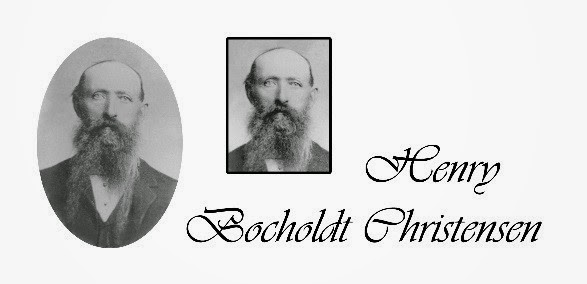
I was touched in researching another ancestor, my Grandmother Hansen’s mother’s father Henry Bucholdt Christensen. Grandmother’s mother had died bearing her 10th child and her father had married two other times. He had three children with his third wife, but none of Grandmother’s family knew much of his second family and almost nothing about Grandfather Christensen. However my great-aunt Agnes wrote, “I’ve never heard very much about my great-grandfather. .  and wanted to know more about this grandfather . . . [I] called grandfather’s daughter Katherine . . .  and will now proceed to write his history as I understand it.”  It was this history, by Agnes, that was the most complete history of him that I found. I know without it, we wouldn’t have known nearly as much about him.
My saving all those biographies throughout the years--including those old mimeographed ones I got from my grandmother—were the basis for my biographies. I couldn’t have written the biographies without them. 

I turned in my history of Niels Peter Hansen to the DUP last year. I was touched recently when I saw it on Family Search submitted by someone I didn’t know. I was ashamed to think I hadn’t even thought to put it on Family Search. So I put my recently completed Henry Bocholtz Christensen’s biography on Family Search so others could learn about him.

There are many ways you can help in Family History: You can collect biographies and information (like I did for over 60 years); you can actually interview and write the histories (like my great-aunt Agnes), you can share histories; you can help others learn how to research and write histories; you can collaborate with others, whether it is family, DUP and or at reunions. You can encourage children, youth and the younger generation as my grandmother did. Everyone can share what they have in Family Search. Everyone has a role in family history.

Wednesday, April 23, 2014

Computers, Technology and Me!


I love computers! I think they are the most outstanding invention of our century. But then I am an early adopter of technology! 

My father had one of the earlier televisions in the Wasatch Front, back
in 1950 when there was only one station---KSL. I remember watching Howdy Dowdy on it when I was only six years old. Maybe that was why I love technology!
 I worked with the first “computer” in 1982 when I took a basic programming class from Enterprise State Jr. College. It was very basic, but I remember making stick people who waved as well as mathematical computations and other things. It was not made for personal computers, mind you, but for main-frame computers, which were the only thing available at the time.

In 1984 we moved to Vicenza, Italy and it was there we purchased the first “personal computer”—an Apple II-E. I loved it even though it didn’t have a hard drive, but had to boot up with large 5 ½ inch floppies, and then run from other floppies. 

I used it mainly for word processing and kept my journal on it and many other writings, including letters from 1985 on. All my letters to my oldest son, Marlowe while he was on his mission to the Rome, Italy Mission were written on it as well as the letter to my father telling him I was pregnant with my 5th child, Bryan, when I was in my 40s. I remember call my sisters and my Aunt Ruth (my mother’s sister) telling them about it, but I didn’t dare telling my Dad. My Dad had always thought it was Mother having her 7th child, my youngest sister Ann, after having breast cancer, which weakened her so she had her second bout of breast cancer when Ann was a baby. Mother died of metastatic cancer when she was 48. I had had breast cancer six years earlier, and I could imagine Dad yelling at me at telling me I was killing myself having a baby at my age if I called him; so I copped out and sent him a letter written on my trusty Apple II-E and he had time to adjust before he wrote me back.


My children used it for games. I recall that my oldest, Marlowe, bought a computer game based on the book, The Hitchhiker’s Guide to the Universe. However, he’d left his book in storage in Alabama, so when he played the game, he couldn’t remember the answers. So he hacked into the program and discovered the answers, popped back out and put the answer in. (I think that’s called using a “cheat sheet” long before there were “cheat sheets”).

We brought back the Apple II-E we moved back to the Chicago in 1987 and used it even when we lived in Sacramento, California. But when we moved to Centerville, Utah in 1990, and the Personal Computer was becoming ubiquitous, the Apple II-E wasn’t good enough, I had to have a PC. Luckily I had a step-brother who helped me convert all my Apple files into Windows files so I didn’t lose any of my precious files.

It was then I started using WordPerfect for word processing when I started working soon after we moved here. I loved WordPerfect, and I subscribed to a magazine that helped me learn all the tips and tricks of it.

In 1993, I started working in the Church Office Building in the Liahona magazine editorial offices. There I worked as liaison between the editorial and production/design departments. All of the people in our office used MacIntosh (Apple) computers, but I also communicated and converted files from all the translation offices throughout the world and they all used PCs so I was using both PCs and MacIntoshes!!! I loved them both. I was always trying to learn new technology and I even learned Databases, and created a program to track all correspondence that came into the office, until it was rejected, answered or purchased for publication. Those manuscripts purchased would then be tracked through the publication process. If anyone had any problems with their computer, I loved to solve their problems.

In 2000, My husband was working for the Davis School District as a School Technology Specialist
(teaching teachers how to use technology); when a new opening came for another STS, he and Bryan convinced me I wanted to work for the school district so I’d have the same working schedule (including school vacation) as they did. I applied and got the job.

Working as an STS was fascinating because it was two jobs in one—I was a computer trouble-shooter; if a computer had problems, I had to fix it. Often I was intrigued by the puzzle and loved to figure out what was going on and why. Then to solve it. I was much more comfortable with software problems than hardware problems. My husband loved to get into the computer and dissect it. I was trained to do that, but it intimidated me. I much preferred de-coding the software to find the problem.

The second part of my job (and the most important) was teaching the teachers how to use the many types of technology that is now available for them to use! I loved learning how to use everything that was available from projectors in each classroom, to interactive computer games to teach children, and everything in between. I loved learning all the software as well as tablets, phones, laptops, podcasts, electronic storytelling, Photoshop Elements, etc. I could go on forever. All of these items just made teaching fun!!!!!

My dad used a computer until he died—even if it was just playing solitaire. I guess I will be playing with technology (but NOT solitaire) until I am too old to use my hands—but by then it will be voice-activated like Dragon software. But technology makes life fun. At least it will keep my mind active and I can keep up with my grandchildren, and my great-grandchildren.

Monday, March 24, 2014

How a Class I took Taught Me about Learning


I love to learn. I have always loved to learn, and taken classes whenever I could. When we lived in Italy in 1984-87, I was able to complete my Bachelor’s Degree in English by taking classes at the Army base we were stationed at, Vicenza Army Base, through University of Maryland, European Division. However, no matter how many classes I took in Vicenza, there were still classes not available there that I needed to take to graduate. To complete these, I took classes by correspondence, and a creative writing class in Denia Spain on the Costa Blanca during the spring equinox.

One of our discussions onsite in Paris for our class.
     
 And I took, with a girl friend Susan, a one-week class in Paris, France in July 1985, “Expatriate Writers in Paris at the turn of the Century (Fin de Siecle).” We were given a list of eight books that were written by American authors who lived in Paris at the turn of the 20th century to read and evaluate. Then we took the overnight train from Vicenza to
Me on the overnight train from Vicenza Italy to Paris
Paris to join the group of students. We shared a tiny hotel room in the center of Paris and met each day to visit the sites that were important in the lives of the expatriate writers we were studying, Henry James, Edith Wharton and others. We were immersed in the whole “Paris” experience—the art, Art Nouveau, Oscar Wilde, and theater.
       
 Each day was an adventure as we discussed the authors, their books, and the art that influenced them. There were no multiple answer quizzes, no true/false tests. Everything was discussion and dialogue. The two teachers directed the discussions, but allowed free expression and ideas. After classes we met at street cafes and talked some more.
        
As our week drew to an end, we had decided what the thesis of our final paper would be—what direction it would take about which author/s. Then our instructors realized that Susan and I would be leaving from the Paris Train station and our final Paris Project was set. The Paris Train Station was built in the late 1800s and was a favorite site for people to meet and see off their friends as they left for places all over the world. Our instructors reserved a room in the train station and planned a formal “farewell” for Susan and I. It wasn’t a normal party—it would be like someone in 1899 or at the Fin de Siecle would dress and act. Furthermore, each of would choose one individual in one of the books we had read and discussed, come dressed as that person, and stay in character all evening as that person. That would portray our in-depth knowledge of the character and book, and be included in our grade.
  
Susan (far left) in costume at the Paris Train Station  
 
I can remember Susan and I looking all over Paris’ flea market for something to transform our clothes into a turn of the century costume that we could remove in a second after we boarded the train to look normal. My final costume included my black slip wrapped around my head; I purchased a flamboyant feather plume, black gloves, and a large black nylon scarf/shawl that I wrapped around to look like a long skirt. You can see Susan in
Me for my final project at the Paris Train Station
the mirror taking the photo, with a red wrap, paisley full slacks and one of my print scarves on her head. 

      Our teachers and others wore more elaborate costumes, but it was a fun and exciting experience to pretend to be a fictional character and to try to remember everything. I can only recall that I was a character from an Edith Wharton novel, and worried that someone would catch me making an error about a fact. I had to make up some reason for her to be taking the train to Vicenza because in the book she never went there—but that was acceptable.
      
Our instructors at the Paris Train Station
 
What did I learn from this class, besides the material taught in the class? I learned how you can make any class more interesting by making it more personal. You can relate anything to the student’s life and it will become more alive to them. You can involve them in role-playing and they will understand how another person feels.

I learned from that class that teaching is more than lecture—speech, talk, discourse. Teaching is imparting knowledge, enlightening, educating (teaching comes from “to lead forth”).   

 When teaching is done right, learning is fun.

Going Back in Time--Hawaii 2020, part 3

Wilder Road We got off the main highway on Kaumana Drive and turned onto Wilder Dr...